
Use cases · SGP.32 IoT eSIM
SGP.32 testing for IoT eSIM, in the field on live networks
SGP.32 field testing proves that an IoT eSIM profile downloads through an eIM, enables on a real eUICC, and then attaches and carries traffic on the live network it was built for. SimCheck.ai runs that sequence on real cellular modems — download through a cloud eIM, attach on the radio technology you choose, then data or MQTT checks — so you know a profile works in the field before your devices depend on it. It complements the lab conformance testing defined in SGP.33 rather than replacing it.
SGP.32 is shipping. Field evidence is scarce.
SGP.32 succeeds the operator-driven SGP.02 model for IoT with an eIM that tells a device's IoT Profile Assistant (IPA) to fetch, enable and switch profiles from any operator's SM-DP+. On paper that ends operator lock-in for devices that will spend a decade in the field. In practice it adds a chain of components — eIM, IPA, eUICC, SM-DP+ and the visited network — often from different vendors, all of which must work together on a device nobody can reach by hand.
Conformance tests prove each component follows the specification in a lab. They don't prove that your operational profile, from your SM-DP+, attaches on NB-IoT in the country where your devices are installed, or that a device recovers when a switch goes wrong. Without field evidence, those problems surface after devices ship, when the fix may mean a site visit.
How SGP.32 field testing works
- 1
Register the operational profiles
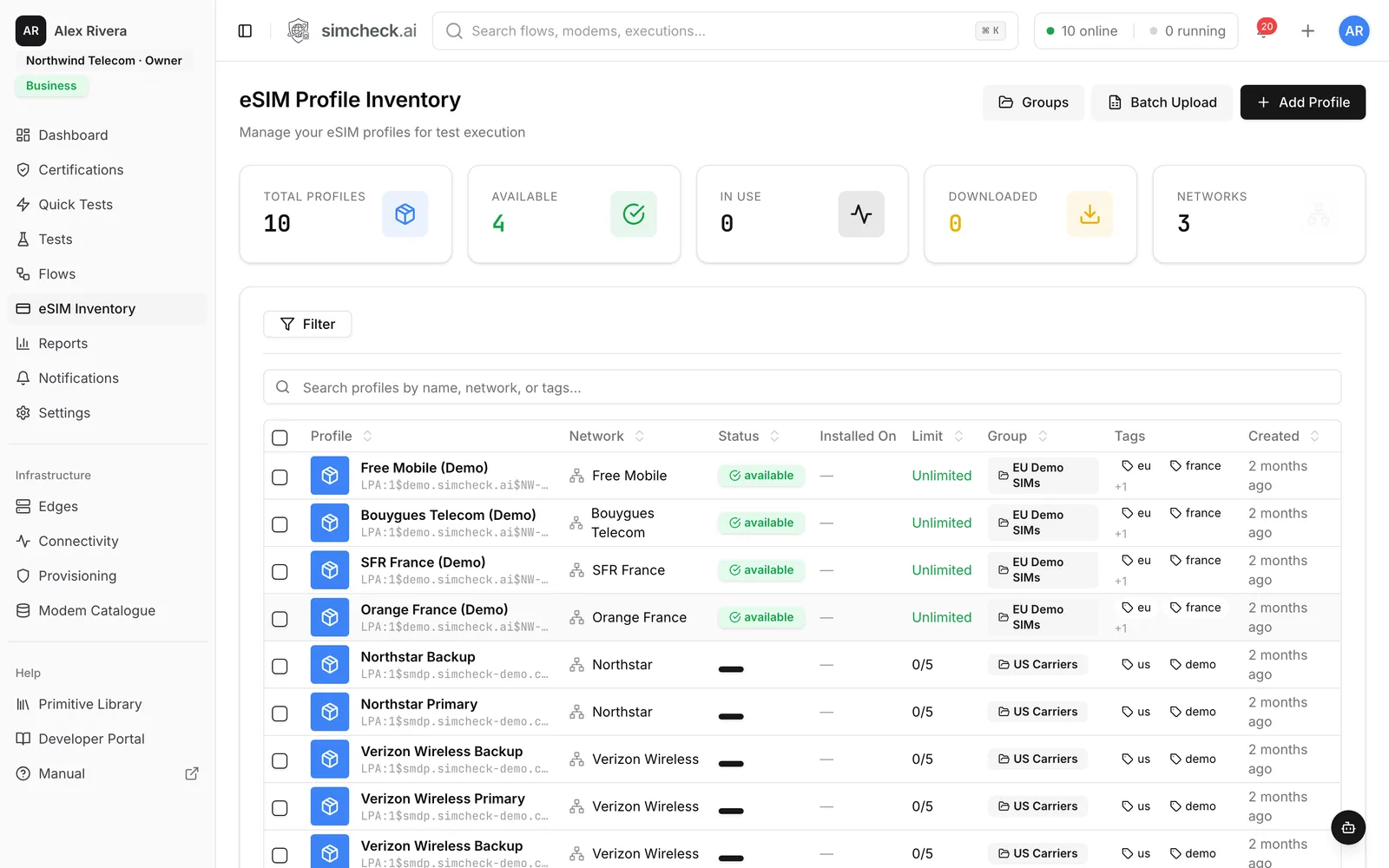
Add each profile's activation code to the eSIM inventory, tag it with its network and group profiles by country or operator so a test can draw any free one.
- 2
Deliver through the eIM
On modems set to SGP.32 delivery, SimCheck.ai downloads the profile through a cloud eIM and enables it on the modem's eUICC — the same download-and-enable step your devices perform in the field.
- 3
Prove the profile on the network
Confirm registration on the expected operator and radio technology, then run a data or MQTT round trip. Force LTE-M or NB-IoT, lock the PLMN or override the APN when needed.
- 4
Repeat across markets and over time
Fan the test out across a cluster, schedule it, and compare results in reports. Failed downloads and rejected attaches show their reason and decoded signaling.
What SimCheck.ai verifies on an SGP.32 profile
eIM-driven profile download
Profiles install through SGP.32 via a cloud eIM, or through an SGP.22-style LPA when you want to compare paths. The method is set per modem.
Your real SM-DP+
Activation codes point at your own SM-DP+, so every run exercises the real download from your profile provider, not a stub.
Install failures with a reason
A bad activation code, an exhausted download limit or a full eUICC is reported as an eSIM provisioning failure on the run, not a silent timeout.
LTE-M and NB-IoT attach
Force the technology and confirm registration, operator, band and RSRP, RSRQ and SINR, with the decoded reject cause if attach fails.
MQTT round trip
The IoT (MQTT) test completes a publish/subscribe round trip through a managed broker, proving application traffic flows on the new profile.
Download-limit tracking
Track single-use and limited-count activation codes, see which modem holds each profile, and raise a limit when your provider allows another install.
Multi-day stability
On your own edge devices, a Persistent Attach run holds the profile on the network for days and records every detach and failure cause.
Hardware that matches yours
The Modem Catalogue lists each supported module's capabilities — eSIM, LTE-M, NB-IoT and bands — so your own edge can mirror your device's radio.
What to test on an SGP.32 device in the field
Lab conformance covers protocol correctness. These checks cover whether a deployment works:
- Profile download via the eIM. The eIM-triggered download completes from your SM-DP+ and the profile lands on the eUICC. See what is an eIM.
- Bootstrap to operational switch. Once the operational profile is enabled, the device attaches on the intended network without manual help. See bootstrap profile.
- Fallback and rollback. If the new profile can't attach — wrong APN, no coverage, no roaming agreement — the device should return to a working profile instead of going dark. SGP.32 defines rollback and fallback mechanisms; verify your device and eIM actually use them.
- Radio access. The profile registers on NB-IoT or LTE-M in each target country, on bands your module supports. See NB-IoT vs LTE-M testing.
- Application traffic. An MQTT publish/subscribe round trip succeeds over the new profile and APN.
- Stability. The device stays attached for days, not minutes, and recovers from network-initiated detaches.
- Inventory hygiene. Failed attempts don't burn single-use activation codes.
For a full walkthrough, read how to test SGP.32 devices.
Field testing vs SGP.33 lab conformance
The GSMA's SGP.33 test specifications cover the IoT eUICC (SGP.33-1), the IPA (SGP.33-2) and the eIM (SGP.33-3); version 1.2 of all three was published in January 2025, enabling certification. Field testing answers a different question.
| SGP.33 conformance (lab) | Field testing (SimCheck.ai) | |
|---|---|---|
| Question | Does each component follow the spec? | Does this profile work on this network, here, today? |
| Environment | Conformance test tools | Real modems, real SM-DP+, live networks |
| Scope | One component at a time | eIM, IPA, eUICC, SM-DP+ and visited network together |
| When | Before certification | Before launch, after every change, continuously |
| Output | Certification evidence | Pass/fail per network with logs, signaling and captures |
A certified eUICC and a certified eIM can still fail together on a live network if an APN, roaming agreement or band is wrong. You need both. More on SGP.33.
Where SGP.32 stands
- SGP.31 v1.0, the eSIM IoT architecture and requirements, was published in April 2022.
- SGP.32 v1.0, the technical specification, followed in May 2023, and v1.2 in 2024.
- Giesecke+Devrient announced the first GSMA-certified SGP.32 IoT eUICC in April 2025.
- Commercial SGP.32 SIMs are arriving — for example, Telenor IoT opened orders in February 2026, shipping from April 2026.
- Kaleido Intelligence, as reported by RCR Wireless, forecasts SGP.32 profile downloads rising from about 2.89 million in 2025 to about 194 million in 2029.
SGP.32 is not backward compatible with SGP.02, but it reuses the SM-DP+ infrastructure of consumer SGP.22. Compare them in SGP.32 vs SGP.22 vs SGP.02.
Frequently asked questions
What is SGP.32 testing?
SGP.32 testing verifies IoT eSIM components and profiles built to the GSMA SGP.32 specification. Lab conformance testing (SGP.33) checks each component; field testing confirms that a real profile downloads through an eIM, enables, attaches on the live network and carries traffic.
How is SGP.32 different from SGP.22 and SGP.02?
SGP.02 is the older M2M model, where the operator's SM-SR pushes profiles. SGP.22 is the consumer model, where the user triggers downloads through an LPA. SGP.32 is the IoT model, where an eIM instructs the device's IPA and the SGP.22 SM-DP+ infrastructure is reused. It is not backward compatible with SGP.02.
Does field testing replace SGP.33 certification?
No. Certification proves each component conforms to the specification. Field testing proves that your profiles, SM-DP+, APNs and roaming arrangements work together on live networks. Most programs need both.
Can SimCheck.ai test SGP.32 profiles from my own SM-DP+?
Yes. Add the profile's activation code to the eSIM inventory. On modems set to SGP.32 delivery, the profile is downloaded through a cloud eIM from the SM-DP+ named in the code, then tested on the live network.
Which radio technologies can SGP.32 profiles be tested on?
Any technology the modem supports — NB-IoT, LTE-M, LTE, 5G NSA or 5G SA. The Modem Catalogue shows which supported modules handle eSIM downloads and which support LTE-M and NB-IoT, so you can plan the right hardware.
What happens if a profile download fails?
The run stops early and reports an eSIM provisioning failure with the reason, such as a bad activation code, an exhausted download limit or no room on the eUICC. A notification links to the run and its logs.
Keep exploring
- LearnWhat is SGP.32? The GSMA eSIM IoT standard explainedSGP.32 is the GSMA eSIM IoT standard for remote profile provisioning. Learn the architecture (eIM, IPA, SM-DP+), download flow, versions and 2026 adoption.
- LearnHow to test SGP.32 devices: a practical field-test guideA practical SGP.32 test plan: SGP.33 lab conformance vs field validation, eIM, download, profile switch, fallback, attach, MQTT, roaming and a full checklist.
- LearnWhat is an eIM? The eSIM IoT remote Manager explainedAn eIM manages eSIM profiles on SGP.32 IoT devices. Learn what it does, how it differs from an SM-SR, its security model, and what to verify when choosing one.
- Use casesIoT Connectivity TestingVerify NB-IoT and LTE-M attach, MQTT round trips and multi-day stability on real modems in every market you deploy.
- GlossaryIPA (IoT Profile Assistant)The IPA is the SGP.32 component that downloads and manages eSIM profiles on an IoT device on behalf of an eIM, taking the role the LPA plays in consumer eSIM.
- BlogSGP.32 Goes Commercial: What to Test in 2026SGP.32 IoT eSIM moved from specification to shipping SIMs in 2026. Where the standard stands, what changes for IoT teams and a practical test plan.
Validate your SGP.32 profiles in the field
Start a 30-day free trial, or talk to us about testing your SGP.32 profiles in every country your devices ship to.