
Use cases · 5G SA
5G SA testing on real 5G modems and live networks
5G SA testing verifies that a SIM can register on a 5G standalone network — with a 5G core rather than an LTE anchor — and that data and voice perform as expected once it does. SimCheck.ai lets you force 5G SA or 5G NSA on real 5G modems, confirm registration, measure throughput with iperf3 and speed tests, check latency, and repeat the same test on roaming partners.
A 5G icon doesn't mean standalone
Many 5G networks still run in non-standalone (NSA) mode, where the device keeps an LTE anchor and the LTE core manages the session. Standalone (SA) 5G uses the 5G core end to end, and it is what enables network slicing and VoNR. For an operator or MVNO launching SA, the question isn't whether the device shows a 5G icon. It's whether the subscription is provisioned for the 5G core, the device registers on SA, and the data path performs better, not worse.
Problems hide between those layers. A profile may lack SA authorization and silently land on NSA or LTE; the 5G core may reject one subscriber range; throughput may fall short of what the radio promises; or SA roaming may not exist with a partner yet. Lab phones, drive tests and vendor dashboards each see part of the picture. A repeatable test on a real 5G modem, with the technology forced, shows whether SA actually works for your subscribers.
How 5G SA testing works
- 1
Pick a 5G location and profile
Choose a site whose modems list 5G capability, or your own edge with a 5G module such as the Quectel RM520N-GL, and the eSIM profile to test.
- 2
Force 5G SA or 5G NSA
Lock the network type in the test's constraints. Tests only land on modems that support it, so an incompatible choice is flagged up front instead of failing later.
- 3
Measure performance
Check registration, band and signal, then run iperf3 for TCP/UDP throughput, jitter and loss, a speed test for latency and bufferbloat, and a Data Performance Test for HTTP timing.
- 4
Compare and monitor
Run the same test on NSA and LTE, compare by network type in reports, and schedule it to track your SA rollout over time.
What 5G SA testing covers
Forced 5G SA and NSA
Lock the radio technology to 5G SA or 5G NSA, with LTE, LTE-M, NB-IoT, 3G and 2G available for comparison.
Registration and signal
Registration state, operator, technology, band and signal quality, with the decoded reject cause if the network refuses the SIM.
Throughput
iperf3 TCP and UDP throughput with UDP jitter and packet loss, plus a speed test with download, upload, ping, jitter and bufferbloat.
Latency
Ping, HTTP timing and loaded latency show whether SA's lower-latency promise holds on the live network.
Modem × RAT comparison
A built-in report shows whether 5G is actually faster on each modem, or whether one is quietly flat-lining on LTE.
5G SA roaming
Force a partner's PLMN with 5G SA to see whether standalone roaming works yet, or where roamers fall back to NSA or LTE.
VoNR checks
Place a real call with the Voice Call Check and see whether it was carried as VoNR, VoLTE or circuit-switched.
Network slicing validation
Include 5G SA and network slice validation in your 5G test program. Slicing setups differ by operator, so we plan slice tests with you.
5G SA vs NSA, and what each test proves
| 5G NSA | 5G SA | |
|---|---|---|
| Core network | LTE core (EPC) with an LTE anchor | 5G core (5GC) |
| Registration | LTE attach, then a 5G NR leg is added | 5G registration directly on NR |
| Voice | Usually VoLTE on the LTE anchor | VoNR, or fallback to LTE for voice |
| Network slicing | Not available | Available |
| A forced test proves | The device can add 5G capacity on that network | Subscription and device work with the 5G core end to end |
Run both. If a SIM passes on NSA and fails on SA, the cause is often subscription provisioning in the 5G core or device support rather than radio coverage — and the decoded reject cause usually says which.
Measuring 5G SA performance properly
A single speed-test screenshot says little about a network. A more useful approach:
- Use the right tool for the question. iperf3 measures raw TCP and UDP capacity, jitter and loss against a server; the LibreSpeed-based speed test reflects what an app sees, including bufferbloat under load; the Data Performance Test adds HTTP timing.
- Compare like with like. Run the same test at the same site forced to 5G SA, 5G NSA and LTE, and compare by network type in reports.
- Look at percentiles, not one run. Schedule the test and report P50 and P95 latency and throughput over days, so no single sample decides.
- Record the radio. Band and RSRP, RSRQ and SINR are captured with every run, so a slow result can be traced to coverage rather than the core.
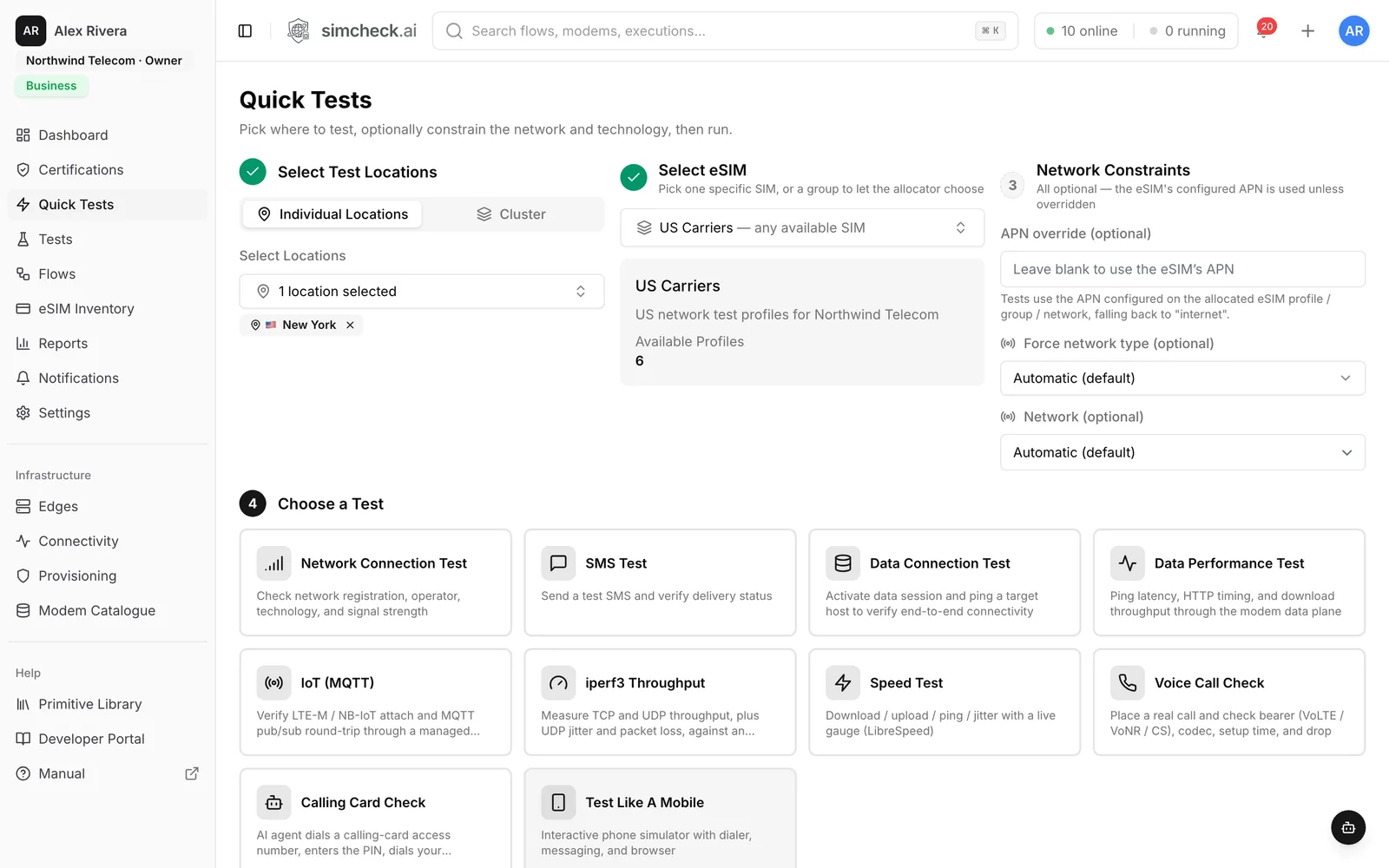
Every test is a Quick Test you can save, schedule or chain into a flow.
5G SA roaming and network slicing
5G SA roaming needs new interconnect arrangements between operators, and many partners don't offer it yet, so a roamer on a 5G SA home plan often lands on NSA or LTE abroad. Forcing 5G SA with a partner's PLMN shows which agreements already support standalone roaming, and a scheduled run reveals when one goes live. Pair it with roaming testing for data, SMS and voice, and with VoLTE and voice testing for VoNR.
Network slicing depends on 5G SA. SimCheck.ai supports 5G SA and network slicing validation as part of a 5G test program; because slicing setups differ between operators, contact us to plan slice-specific tests.
Frequently asked questions
What is 5G SA testing?
5G SA testing verifies that a SIM and device register on a 5G standalone network, which uses the 5G core rather than an LTE anchor, and that data, latency and voice perform as expected. It usually compares results against 5G NSA and LTE on the same network.
What is the difference between 5G SA and 5G NSA?
5G NSA adds 5G radio capacity to an LTE connection and relies on the LTE core. 5G SA connects to a 5G core directly, which enables network slicing and VoNR. A SIM can work on NSA and still fail on SA if it isn't provisioned for the 5G core.
How do I know if my SIM is on 5G SA?
Force 5G SA in a test. If the SIM registers, the result shows the technology, band and signal. If it can't, the run fails with a reason instead of silently falling back, and the decoded signaling shows the network's reject cause if there was one.
How do you measure 5G throughput and latency?
Use iperf3 for raw TCP and UDP throughput, jitter and loss, and a speed test for download, upload, ping and bufferbloat. Repeat on a schedule and compare percentiles, not single runs.
Does 5G SA roaming work?
With some partners. 5G SA roaming needs dedicated arrangements between operators, and many don't offer it yet. Forcing 5G SA on each partner's PLMN shows which agreements support it today.
Which modems support 5G SA testing?
5G modules such as the Quectel RM520N-GL in the Modem Catalogue. Each SimCheck network site also lists what its modems can do, so you can pick a 5G-capable location before you book a test.
Keep exploring
- Glossary5G SA (5G Standalone)5G SA (Standalone) is 5G with its own 5G Core and no LTE anchor, enabling network slicing and VoNR. Learn how it works and how it differs from 5G NSA.
- Glossary5G NSA (5G Non-Standalone)5G NSA (Non-Standalone) adds 5G NR radio capacity to an LTE network, using LTE as the anchor and the 4G core. Learn how EN-DC works and its limitations.
- Use casesVoLTE & Voice TestingPlace real calls and see IMS registration, bearer, setup time, outcome and a recording — at home and roaming.
- Use casesRoaming TestingLock tests to each partner by PLMN, verify data, SMS and voice, and track every pair in a roaming matrix.
- PlatformQuick TestsTen ready-made tests — attach, SMS, data, speed, iperf3, MQTT, voice and more — run on real modems in one click.
- SolutionseSIM Testing for Mobile Operators & MNOsAutomated eSIM, roaming, VoLTE and 5G testing for mobile operators. Validate SGP.22 and SGP.32 profiles and roaming partners on live networks with AI.
See whether 5G SA really works for your subscribers
Start a 30-day free trial, or talk to us about 5G SA, roaming and network slicing validation on your networks.